
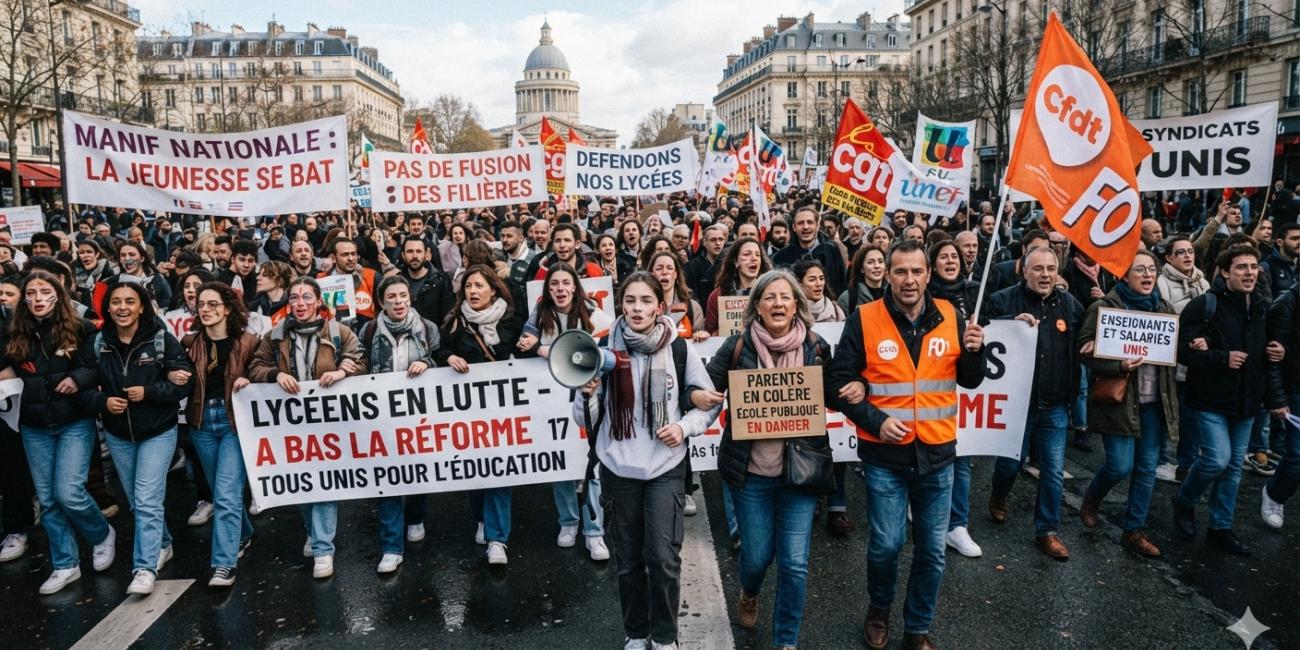
French students, parents and trade unions staged demonstrations across more than 30 cities on Tuesday, October 6, 2026, as protesters demanded increased government investment in schools and better learning conditions.
The protests, taking place in Paris, Marseille, Nice, Nantes, Lyon, Lille and other cities, were reported by the BBC, which said students were protesting overcrowded classrooms, teacher shortages and deteriorating school buildings.
The demonstrations have spread from high schools to universities, with student groups calling for urgent action from the government.
The Union Syndicale Lycéenne (USL), one of the groups organising the protests, claimed that about 1,800 high schools had been blockaded or closed by Tuesday.
The union also claimed that 90% of universities were blockaded and described the level of mobilisation as a new record.
The students are demanding the creation of 150,000 additional higher education places, €10 billion for emergency reconstruction of schools and the mass recruitment of teachers.
The union said the measures were necessary after previous petitions and demonstrations failed to produce a sufficient response from political leaders.
The protests have also been accompanied by clashes and injuries.
More than 5000 people had been arrested during the past week, while at least 215 students had been injured, according to the government. Some schools have also been closed or affected by the unrest.
In the northern city of Lens, a 15-year-old student suffered severe injuries after a sting-ball grenade exploded during a confrontation between protesters and police on Monday.
Pas-de-Calais prefect François-Xavier Lauch said the teenager’s life was not in danger but described the incident as “very serious”.
Authorities said riot police had been deployed near Auguste Béhal High School after students allegedly threw stones, fireworks and mortars at officers.
However, accounts differ over how the grenade caused the teenager’s injury, with some students claiming he was hit directly by an officer while authorities said he picked up the device.
The French police watchdog, the General Inspection of the National Police (IGPN), is investigating the incident.
The unrest has led to further injuries in recent days.
A 14-year-old student was reportedly struck in the head by a tear-gas canister last week and suffered a fractured jaw, while another 16-year-old student lost the use of his right eye during a school blockade in Tours.
In Lille, students gathered outside schools and erected barricades while demanding greater investment in education. Bins were set on fire outside Lycée Fénelon before firefighters arrived, while police remained nearby as the demonstrations continued.
Parents have also joined some of the demonstrations through a movement known as “Parents Present”. In Marseille and other cities, large crowds gathered with banners, while police in protective equipment were deployed around some protest areas.
The demonstrations began with high school students in the Paris region at the end of September before spreading to other parts of France. Students have complained about shortages of teachers and other staff, overcrowded classrooms and poorly maintained school buildings, with some saying the conditions are affecting their education and future prospects.
Education Minister Édouard Geffray previously acknowledged that some of the students’ demands were legitimate, while government officials have condemned the violence associated with parts of the protests. Justice Minister Gérald Darmanin said a violent minority had been involved and questioned whether all those taking part were high school students.
The demonstrations are expected to continue, with tens of thousands of people anticipated to join marches across France. Further protests and school blockades are planned as student groups and trade unions press the government to address their demands for improved facilities, more teachers and greater investment in education.