
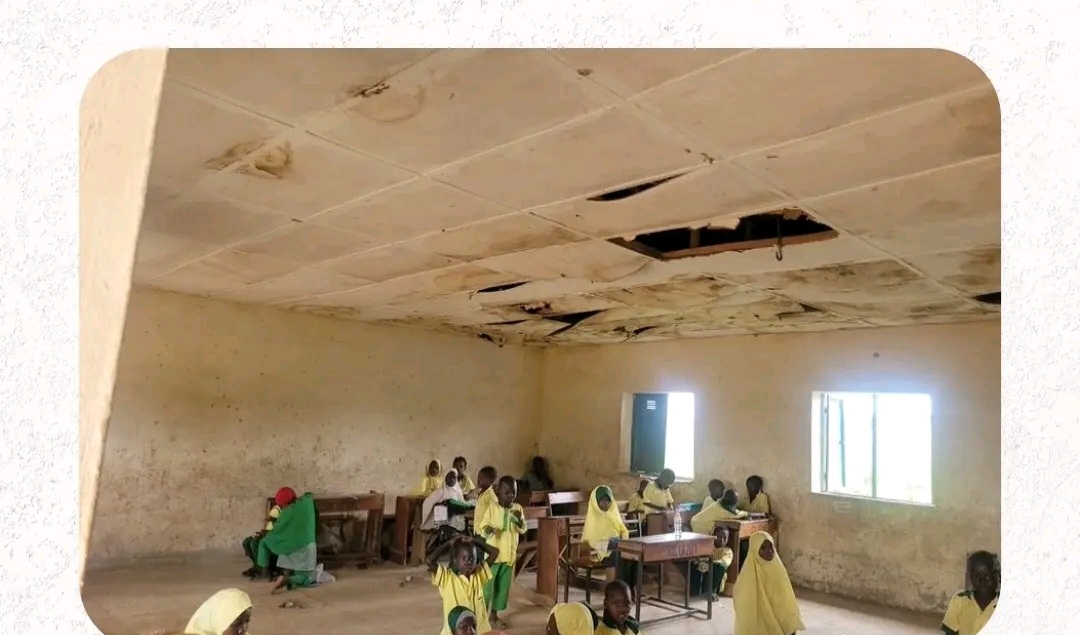
Primary and secondary school pupils at Zariyawa Community School in Zariyawa Maje, Suleja Local Government Area of Niger State, have been forced to sit on bare floors during lessons due to a severe shortage of classrooms, desks, chairs and other basic learning facilities.
This was revealed in a report by a civic tech organisation, MonITNG.
The school, said to be the only educational institution serving children in the community, has only four classrooms serving both primary and secondary school pupils.
The situation has raised concerns over the quality of the learning environment available to children in the community, as pupils are compelled to sit on bare floors during lessons because of inadequate furniture and classroom space.
According to the report, the condition of the school exposes pupils and teachers to an environment that makes effective teaching and learning difficult.
The four available classrooms serve children at both the primary and secondary levels, placing significant pressure on the limited infrastructure.
With inadequate classrooms, desks and chairs, pupils are left with little option but to sit on the floor during lessons, the report noted.
The situation means that children who wake up each morning, prepare for school and walk to the facility may spend hours receiving lessons while seated directly on the ground.
The report described the situation as a reflection of the poor learning conditions confronting children in the community.
“Imagine being a child who wakes up every morning, prepares for school and walks into a classroom, only to have nowhere to sit except the bare floor,” the report stated.
“Imagine trying to concentrate on a lesson for hours while sitting on the ground, simply because your community does not have adequate facilities.”
MonITNG said the pupils deserve the opportunity to learn in a safe, decent and conducive environment, stressing that the problem extends beyond the absence of furniture.
The report noted that the school requires additional classrooms to accommodate pupils at both educational levels, as well as desks, chairs, learning materials, sanitation facilities and other basic infrastructure.
It also highlighted the difficult conditions under which teachers are expected to carry out their duties.
The situation has become a source of concern given that Zariyawa Community School serves as the only school structure available to children in the community.
The report argued that children attending the school should not be treated as second-class citizens simply because they live in a community with inadequate public infrastructure.
“Teachers are expected to educate children under conditions that would make learning challenging for anyone,” the report said.
“This is a community school, but the children attending it are not second-class citizens. Their education matters just as much as that of children in better-served communities.”
“Education should give children hope for a better future, not remind them every day that their community has been left behind,” MonITNG added.
The report also drew attention to the resources available to the Niger State Government, noting that the state received ₦48.37 billion in allocations from the Federation Account Allocation Committee (FAAC) between January and March 2026.
“The Niger State Government received ₦48.37 billion in FAAC allocations between January and March 2026 alone,” MonITNG said.
It questioned why communities such as Zariyawa Maje should continue to have children sitting on bare floors to receive basic education amid the availability of government resources.
“With resources being allocated to government at this level, communities like Zariyawa Maje should not have children sitting on bare floors to receive basic education.”
The report called for urgent intervention by the Niger State Government, the state Ministry of Education and the Suleja Local Government Area authorities.
It urged the authorities to visit Zariyawa Community School to assess the conditions firsthand and take steps to provide adequate classrooms, desks, chairs, learning materials, proper sanitation, and a safe learning environment.
The organisation stressed, “We are not asking for luxury. We are asking for the basics: adequate classrooms, desks and chairs, learning materials, proper sanitation and a safe environment where children can learn with dignity.
“The Niger State Government, Ministry of Education and Suleja LGA authorities need to urgently visit Zariyawa Community School and see the reality for themselves.”
MonITNG asked, “How long should these children continue to sit on bare floors before something is done?” noting, “Their parents deserve better. Zariyawa Maje deserves better.”
The situation at the school highlights the infrastructure challenges that can undermine effective learning for children in underserved communities and raises questions about the distribution and impact of public resources at the grassroots level in Niger State and across Nigerian communities.